An online order may pass through storage, picking, packing, and shipping before it reaches a driver. Robots are becoming more important because they can handle repeatable movement and picking tasks while people focus on work that needs judgment.
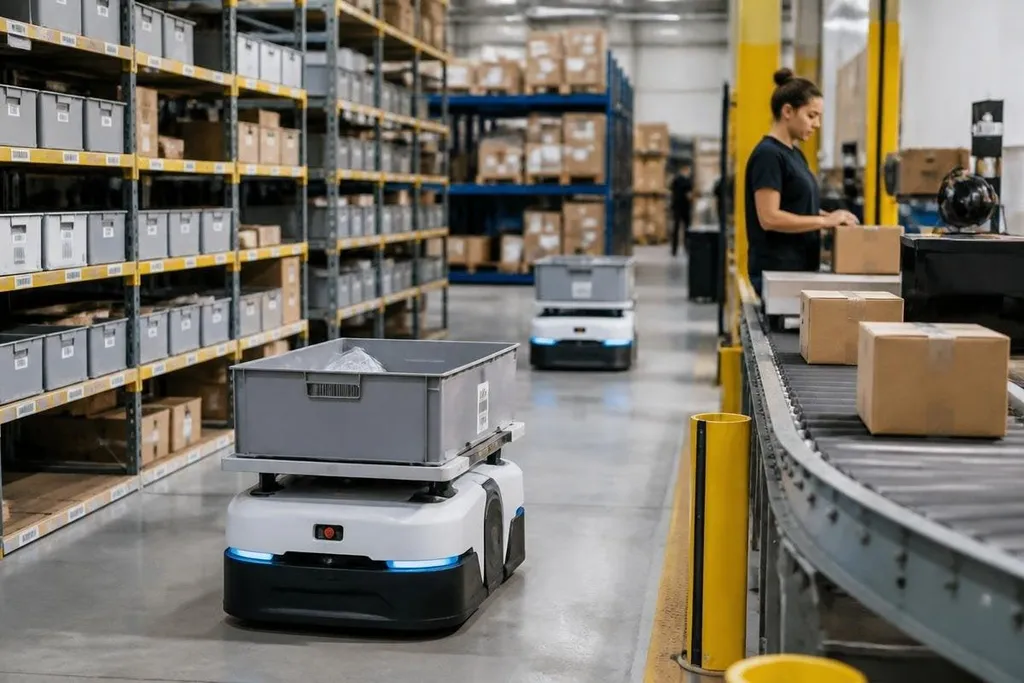
- Mobile robots carry shelves, bins, or parcels between work areas.
- Robotic arms can pick known items from fixed stations.
- Fleet software sends tasks, checks robot positions, and routes work around blocked paths.
The work robots can handle
Most e-commerce robots do not replace a whole warehouse process. They take one task, such as moving a tote, sorting a parcel, or bringing a shelf to a worker, and repeat it through a shift.
A mobile robot uses cameras, LiDAR, floor markers, or other sensors to find its position. LiDAR measures distance with light, so the robot can build a map and avoid people, racks, and other machines. The exact sensor mix depends on the building and the job.
Robotic arms work best when the items are known and the handoff point stays fixed. A gripper can pick a box with a clear shape more easily than a loose garment in a crowded bin. That limit matters because online stores carry many item types, with different sizes, surfaces, and packaging.
Why this matters for online orders
E-commerce demand changes during the day and across the year. A warehouse may need more picking capacity for a short period, then less after the rush. Robots can add workstations or move goods through a building without rebuilding every aisle.
The benefit comes from the task design, not from the word “robot.” If a worker spends much of a shift walking to collect items, a mobile robot can bring the storage location closer to that worker. The worker still checks the item and handles exceptions, while the robot covers the repeated travel.
That change also affects safety and training. A worker may spend less time pushing a loaded cart, but they need to understand traffic rules, charging points, emergency stops, and what to do when a robot stops. A good installation moves risk rather than removing it.
Training matters because a robot that stops at a blocked aisle still needs a person to recover it. E-commerce robotics reporting can show the task, site, test date, and worker role behind a deployment, giving a buyer facts to assess before the article turns to the hard parts inside a warehouse.
The hard parts inside a warehouse
A robot needs more than a motor and a route map. It must share space with people, pallet trucks, shelves, doors, and items that may not sit where the software expects them.
A blocked aisle can delay several tasks if the system has no safe alternate route. Picking is harder than transport because the robot must find the item, decide where to grip it, lift it without damage, and place it in the correct container.
A barcode check can catch a wrong item, but it cannot solve every problem with soft, tangled, reflective, or partly hidden goods. The software also needs clean order data.
If an item location, weight, or stock count is wrong, the robot may perform its assigned task correctly and still send the wrong item to packing. That is why data checks belong in the project plan before new hardware arrives.
A practical buying checklist
Before you compare robot suppliers, check the job in this order:
- Name the task: Measure walking, lifting, sorting, or picking work before choosing a robot type.
- Record the items: List package sizes, weights, surfaces, and the share of goods that need manual handling.
- Map the site: Check aisle width, floor condition, doors, lifts, charging space, and people crossing routes.
- Test exceptions: Include blocked paths, missing stock, damaged labels, dropped items, and emergency stops.
- Count the support work: Price software, training, repairs, spare parts, batteries, and changes to the building.
- Set a result: Choose a measure such as items per hour, walking distance, picking errors, or safe operating hours.
I'd skip any project that starts with a robot model before it has measured the task. A clear work problem gives the system a fair test; a vague goal leaves the hardware carrying a promise it can't prove.
E-commerce robots matter because online orders create repeated physical work across storage and shipping. The next useful question is narrower: which task can a robot perform safely, with fewer errors, and at a cost the warehouse can measure?